Trending Left Blog

My 3 Biggest Lessons From One Year of Making YouTube Content
My 3 Suprising Lessons From One Year of Making YouTube Videos.
About a year ago, I hit “upload” on my first YouTube video with very little idea of what I was doing. I didn’t know anything about YouTube growth, nor did I have the technical skills required to run a podcast. The only thing I really knew how to do was talk about current events and politics.
Twelve months and nearly 200 videos later, creating content has become one of the most challenging, eye-opening, and unexpectedly meaningful experiences of my life. It has taught me lessons that have changed how I think about storytelling, politics, audiences, and even myself.
Here are the biggest lessons I’ve learned after one full year of making YouTube content.
1. Politics Is Even More Divisive Than I Thought
I always knew politics was polarizing — but I didn’t fully grasp just how reactive and emotionally charged online political conversation has become until the comments started rolling in on my videos. It wasn’t just disagreement; it was people treating a 10-minute YouTube video like an existential threat to their worldview.
Like bro, I’m just sitting in my bedroom with a $40 camera attached to my borrowed laptop, recording myself giving my opinions on politics after a 10-hour day at my regular job. I only have like 1,500 subscribers. I am grossly unimportant in the political commentary space… it’s not that deep. But to many people, it is that deep.
If I said something mildly critical of a political figure they supported, I’d get hundreds of comments calling me biased, brainwashed, or worse — gay. “Gay” isn’t actually worse (or bad at all), but to MAGA, using gay (and other colorful synonyms) as a slur — not merely in a joking manner — is quite popular. And I don’t mind being called that. I’m secure enough in my sexuality to not give a sh*t what someone who doesn’t know me says about me. In my view, it actually shows their fragile masculinity if they feel the need to attack someone for allegedly lacking their preferred masculine traits.
If I said something sympathetic about a marginalized group, the same people accused me of “pandering” or “trying to destroy the country.” If I questioned a viral narrative, people jumped to the most extreme interpretation possible.
What shocked me wasn’t the negative comments themselves — it was how predictable they became. After a while, I could almost forecast which lines in my video would set people off, which political tribes would show up in the replies, and which talking points would repeat like clockwork.
What I learned:
Politics online isn’t about conversation — it’s about identity.
Once you understand that, the hostility makes more sense. People aren’t defending a policy; they’re defending their sense of belonging.
This lesson made me recalibrate how I approach political topics. I’ve recently stopped chasing virality through outrage and instead started focusing on clarity, nuance, and, frankly, sanity. That shift hasn’t (and won’t) eliminate the angry comments — but hopefully it will cultivate a much healthier community going forward.
2. Most People Online Aren’t Trying to Understand You — They’re Trying to Win
One of the harshest but most eye-opening lessons from my first year on YouTube is that most people who comment aren’t there for a conversation. They’re there for a debate. Or, more accurately, they’re there to win a debate that only exists in their head.
I learned this the hard way.
Whenever I posted a video with nuance, people responded as if I’d taken the most extreme position imaginable. If I questioned something from the left, people accused me of being a secret conservative. If I criticized a conservative talking point, suddenly I was a “woke extremist.” There was no curiosity about my point of view, no genuine attempt to understand the full argument — just a drive to score points. Just a drive to protect their identity (which they apparently thought I was threatening?).
After a while, I stopped expecting genuine dialogue in the comments. Not because people are bad, but because people online don’t respond to your actual words; they respond to the version of you that exists in their mind. And in political content, that version is usually exaggerated, simplified, and engineered for conflict.
Ironically, when I did get thoughtful comments, they came from viewers who clearly watched the entire video and actually wanted to engage, not attack. Those comments made the entire year worth it.
But the overall lesson?
Don’t create for the debaters. Create for the people who listen.
3. Traveling While Creating Content Changed the Way I View Censorship
One unexpected part of my year as a creator was how much travel influenced my perspective — especially my perspective on political speech and censorship.
This year I traveled to Italy, Turkey, Ireland, New York City, and South-Central Texas. Each place has its own culture, its own attitude toward politics, and its own level of comfort with public criticism of leadership or government.
But the biggest shift came from my trip to Turkey.
Leading up to the trip, I was honestly nervous. I had publicly criticized President Erdoğan in past videos and posts, pointing out authoritarian tendencies, democratic backsliding, and the erosion of free press protections. And even though I’m just a small creator, I still had that little voice in the back of my mind whispering:
“What if they flag your passport?”
“What if they pull you aside?”
“What if they detain you for something you said online?”
I texted a few friends before the trip and warned them that I might be visiting a place where I could be kidnapped by the government. I asked them to look after my dog and take care of my family if I died. They all responded — seemingly in unison — with something to the effect of, “you’re a f*cking idiot Justin LMAO.”
It sounds dramatic, but Turkey has detained larger political commentators. And when you create political content — even as commentary, even in good faith — you become aware of how different the world can look depending on who’s in power. And when you travel internationally, that awareness becomes far more real.
While exploring Istanbul, I met a woman named Zay. After some conversation, she told our group about the political unrest in the city — namely the protests and outrage over the mayor, Ekrem İmamoğlu, being jailed for political reasons by President Erdoğan. She explained, and I later researched and confirmed, that Erdoğan has weaponized the justice system to silence İmamoğlu, who is seen as a strong opponent in a future presidential race.
Standing in Istanbul, walking through districts where journalists have literally been arrested for criticizing leadership, I understood something that I had only understood abstractly before:
Freedom of speech is not just an American value — it’s a privilege that varies wildly depending on which border you cross.
The trip changed me. It made me both more grateful for what I can say and more aware of how fragile that ability is. It also made me think about how creators in less democratic countries navigate their platforms carefully, choosing their words strategically, knowing that a video isn’t just content — it’s a risk.
Seeing the global landscape firsthand reshaped my approach to political commentary. I’m more thoughtful now, not out of fear, but out of respect. Not every country lets you press “upload” without consequences. And that reality deepened my understanding of the responsibility — and luxury — of doing this work.
My Review of Professor Brian Cox’s Horizons: A 21st Century Space Odyssey
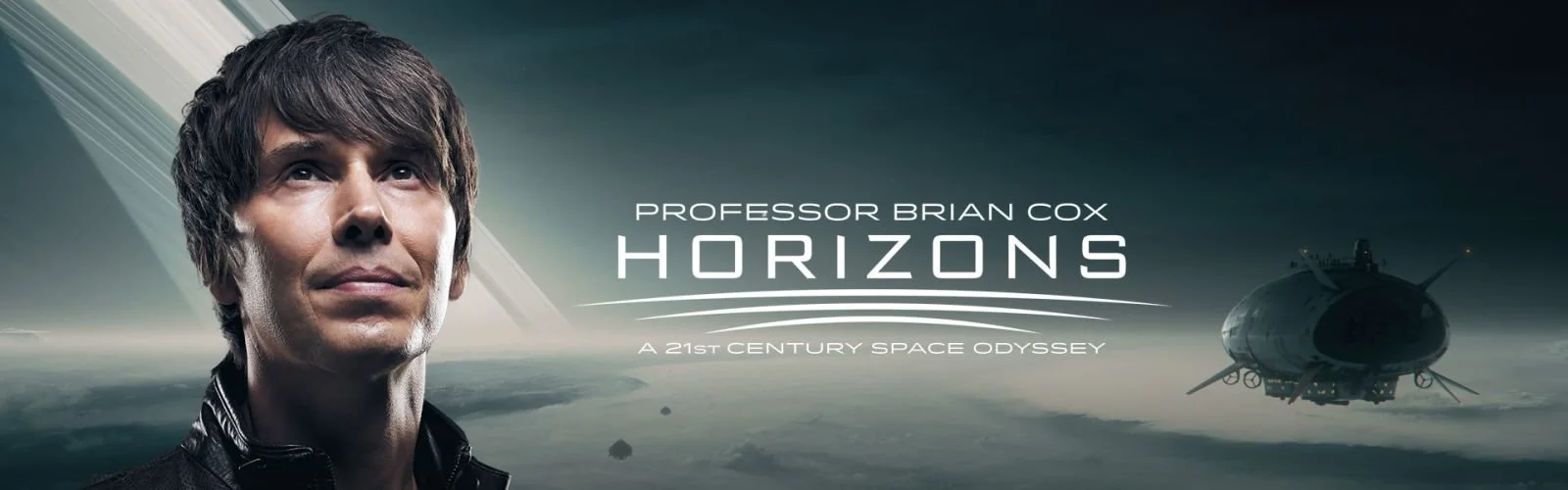
World-renowned physicist Brian Cox has a rare gift: he can explain complicated scientific concepts in a way that even I—a mere mortal and science novice—can understand. Specializing in particle physics, Professor Cox has dedicated much of his career to studying black holes and astrophysics more broadly.
If you’re a normie like me and not quite sure what astrophysics is, let me break it down quickly:
Astrophysics is a branch of science that applies the laws of physics and chemistry to understand the universe and our place in it. It involves studying the formation, evolution, and behavior of stars, planets, galaxies, black holes, and other cosmic structures. Astrophysicists explore phenomena like star formation, galaxy evolution, dark matter, dark energy, and the possibility of life on other planets.
There isn’t a strong enough word to describe how cool that is.
Yes—science is cool. At least this branch of it, anyway.

image from concreteplayground.com
But let’s be real: the cosmos is complicated. The physics involved in measuring and understanding cosmic structures is incredibly complex. Albert Einstein and Stephen Hawking—names you’ve probably heard—made legendary contributions to physics and astrophysics. They were the brains. Professor Brian Cox is the translator—the one who helps the rest of us understand and appreciate their groundbreaking work.
Horizons: A 21st Century Space Odyssey
Horizons: A 21st Century Space Odyssey is an international stage tour in which Professor Cox unpacks the latest in astrophysics with clarity, wonder, and mind-bending visuals.
I’ve followed him for years—mostly on YouTube and through TED Talks. So when he announced a world tour a couple of years ago, I was ecstatic. I rushed online to buy a ticket, only to find the first leg of the tour was primarily in Europe. So I waited. Patiently. For nearly two years.
Then, this past winter, he announced a show in Chicago for May 2025. I snagged a ticket as soon as they went on sale. And on Saturday, May 3rd, I finally attended.
Here’s my short review:
It was amazing. And inspiring.
With his signature soothing voice and his talent for breaking down complex topics, Professor Cox guided us through the mysteries of the universe. But he didn’t come alone—he brought stunning visuals: ultra high-resolution, vibrant images and videos of distant planets, black holes, galaxies, and more. All of it projected onto a jaw-dropping 30-meter-wide, 10-meter-high LED screen.
I would’ve taken photos—but they weren’t allowed in the theater. (Trust me, someone tried and was nearly escorted out.) This physics stuff must be highly classified, huh.
Throughout the show, he covered all the major topics in astrophysics and walked us through the history of the field, frequently quoting and honoring pioneers like Carl Sagan, Albert Einstein, Edwin Hubble, and others.
At one point, he even did live math on screen—to the audience’s delight. Using a digital tool, he wrote out formulas that demonstrated the mind-bending reality of time dilation and Einstein’s theory of relativity. It was equal parts brain-busting and exhilarating.
He shared updates on the frontiers of space exploration, including current NASA missions and the ongoing journeys of the Voyager 1 and 2 spacecrafts, which are now 16 and 13 billion miles from Earth, respectively. These marvels of engineering are still transmitting data and photos from the edge of our solar system.
Below is a link to NASA’s webpage on Voyager 1 and 2, where you can view the data and photographs that these spacecraft have transmitted back to Earth. It’s interesting, beautiful, and frightening all at the same time. I encourage you to check out the the link below
🔗 Where Are Voyager 1 and Voyager 2 Now?
Over the course of two hours, Professor Cox masterfully blended a PhD-level lecture on black hole cosmology with thought-provoking reflections on space exploration and humanity’s place in the universe.
Honestly, I’d probably struggle in a university-level course taught by him. I would give professor Cox an A+ grade for this lecture, though. Not only did he explain complex physics in a way that the average joe can understand, but he did so in a way that was artistic and inspiring. He are links to a couple of videos that I think are worth your time watching, if you’re interested in becoming as inspired as I am:
https://youtu.be/urFIHf5coxE?si=1VQMQG4m0bvq5A63
https://youtu.be/pGsbEd6w7PI?si=8KhEuoShlPFRcTbO
For my right-wing readers (if you exist lol), below are links to Professor Cox’s two appearances on the Joe Rogan Podcast that are actually quite engaging and informative. Oops, am I allowed to say that as a leftist?
https://www.youtube.com/live/wieRZoJSVtw?si=0fiDi3t5D-MLcUij
https://youtu.be/Rc7OHXJtWco?si=Ub8W9La9fXDIushd
Thank you for reading :)
-Justin McMaster
USA: The Richest Nation In History - So Why Are We Struggling?
America is great — not necessarily because of what it is right now, but because of what it could be. Our potential is unmatched.
Most of us can agree that we are nowhere near tapping into that potential. We have the largest economy in the history of the world and a tax system that should work for everyone. But here’s the hard truth: it doesn’t.
Right now, 60% of Americans live paycheck to paycheck. Most can’t cover an unexpected $400 hospital bill or car repair without going into debt. Healthcare and housing have become unaffordable for the majority. Medical debt is the #1 cause of bankruptcy. Gun violence remains an unchecked epidemic.
Why? Because when basic services — like healthcare, pharmaceuticals, and energy — are driven by the profit motive, prices are pushed higher, not to serve people, but to maximize shareholder earnings. Private health insurers, for example, charge unaffordable premiums and co-pays on the front end, then deny as many claims as possible on the back end — even when the care is necessary — all to protect profit margins.
This system is not just inefficient. It’s corrupt. It’s inhumane.
Essential services like healthcare and pharmaceuticals should never be driven by the incentive to squeeze consumers for profit. Yet that’s exactly what’s happening — and it’s why we’re falling behind.
On top of this, the ultra-wealthy and large corporations have not paid their fair share of taxes for decades. This is a choice, not an inevitability.
There are so many glaring issues in the United States that can be fixed.
We should be #1 —
#1 in healthcare.
#1 in housing.
#1 in infrastructure.
#1 in transportation.
#1 in everything.
We are the richest country in the history of the world. There is no reason for us to tolerate such deep and widespread economic injustices.
Yet right now, according to major global rankings, we’re not even close:
31st in Education
34th in Environmental Performance
16th in Healthcare
48th in Life Expectancy
29th in Public Transportation
We’re outside the top 10 in many other critical categories.
Simply put: We can — and must — do better.
We have the resources to reform our systems and ensure better outcomes for everyone.
Policies to Unlock America’s Potential
Here’s a short (but powerful) list of policy changes that would move us closer to becoming #1 in the world across the board. This is by no means exhaustive, but it’s a strong start:
Single-payer healthcare / Medicare for All
Reverse the Citizens United Supreme Court ruling
End arms sales to countries that violate human rights (e.g., Saudi Arabia, Israel, Egypt)
Abolish the death penalty
End unilateral wars except as a last resort to defend U.S. territory
End the War on Drugs — favor legalization, regulation, taxation; pardon all non-violent drug offenders; treat addiction as a health issue
Protect free speech on college campuses and support net neutrality
Guarantee universal education as a right, including free tuition for four-year public college and university
Guarantee universal healthcare as a right
Establish federal paid maternity leave, paid vacation, and free childcare
Expand anti-discrimination protections to include LGBTQ+ people
Expand background checks on firearms; ban high-capacity magazines and assault weapons
Fund Planned Parenthood and safeguard reproductive rights
Implement nationwide electoral reform and publicly financed elections — eliminate the influence of big money
Adopt instant-runoff voting to make third-party and independent candidates viable
Implement the Buffett Rule, end offshore tax havens, raise capital gains and income taxes on the ultra-wealthy, and increase the estate tax
Raise the minimum wage to a living wage — start with $17.50 at the federal level and tie it to inflation
Pardon Edward Snowden; prosecute CIA torturers and DoD war criminals; shut down Guantanamo Bay and all extrajudicial prisons; end warrantless NSA spying
Pass the Paycheck Fairness Act
Abolish ICE (U.S. Immigration and Customs Enforcement)
Reform policing — mandate body cameras, establish community oversight boards, eliminate broken windows policing, end stop-and-frisk, and appoint special prosecutors to hold police accountable
Protect Social Security, Medicare, and Medicaid — no cuts, only expansion; establish universal single-payer healthcare
America has the wealth, the talent, and the resources to lead the world — not just economically, but morally and socially.
Let’s stop accepting less. Let’s demand a country that lives up to its extraordinary potential — for all of us.

Blog #1 - Why I’m Doing This
I knew I wanted to advocate for change. But for years, I was silent.
We all have strong opinions about something. But for years, I was silent.
I had always wanted to express my vision for a better America and build a community with like-minded people who are ambitious about changing our political system - and society more broadly - in a progressive way.
It has been five years since my first experience working on a political campaign. Over that time, I struggled to find an avenue into advocacy that I believed could actually work. I thought I needed someone to open a door for me - someone to hold my hand and guide me to an opportunity.
I was naïve.
Recently, I had an epiphany. I realized that, as it is for most working-class people, when you want something, you have to get it yourself.
I had spent years developing my views on politics and the world, and I knew exactly what I wanted to advocate for. In August 2024, I went to my local tech shop and bought the cheapest camera and microphone I could find. Using a borrowed laptop, I just went for it. I started a YouTube channel. I began recording myself talking about topics that are important to me.
Was starting this project uncomfortable and scary as hell? Yes.
I told some people in my life about the project. Their reactions all seemed to say the same thing: “Huh? You? Making YouTube videos? You don’t seem like that type of person…”
I know now that the greatest things in life are on the other side of fear. Is that a quote from Will Smith? It might be.
There are several policy changes that need to happen in the U.S. if our government is to truly represent everyday people. Because right now, it represents the ultra-wealthy. It’s a dark and corrupt system.
We can change it - but it’s going to take the efforts of everyday people like you and me. We need to find ways for our voices to be heard and then advocate for real progress. We can no longer rely on mainstream media. We can no longer rely on fake “independent” news outlets that still take money from, and do the bidding of, billionaires and corporations.
It is time for real progress to be made. Through these blogs and my YouTube channel, I will advocate for everyday people by amplifying progressive policies and calling out corruption and wrongdoing in our government—regardless of political affiliation.
If this message resonates with you, please consider joining the community and adding your voice to the conversation on my YouTube channel